£260

How Much Does Mice Control Cost in Cambridge?

£260. Catching the mice is the straightforward half. Finding out how they are getting in is the half that stops it happening again.

Mice Control Cambridge

£260

Mouse control in Cambridge is £260, confirmed before booking, with no call-out fee.

Here is what that buys, and why the trapping is the less important half of it.

Trapping Is the Easy Part

Anybody can put a trap down, and a trap will catch a mouse. What a trap cannot do is tell you why there were mice in the first place, or stop the next ones.

A house mouse gets in through a gap far smaller than people expect. It climbs confidently, it follows pipe runs and cable routes through cavities, and it will travel a considerable distance inside a structure. So the point where you see one is frequently a long way from the point where it came in.

Which is why the survey matters more than the traps. The question is not “where is the mouse” but “where is the hole”.
Where They Get In

  • Around pipe and cable entries — under the sink, behind the boiler, where the gas or water main enters
  • Air bricks with damaged or missing covers
  • Gaps under external doors, especially where a threshold has worn
  • Where the floor meets the wall in older properties
  • Through a cavity, entered at ground level and travelled upward
  • Round soil pipes and waste pipes where they pass through a wall
  • Gaps at the eaves and under roof tiles, reached from a fence, a drainpipe or an overhanging branch
  • Between adjoining properties in a terrace, which is why a neighbour's problem can become yours
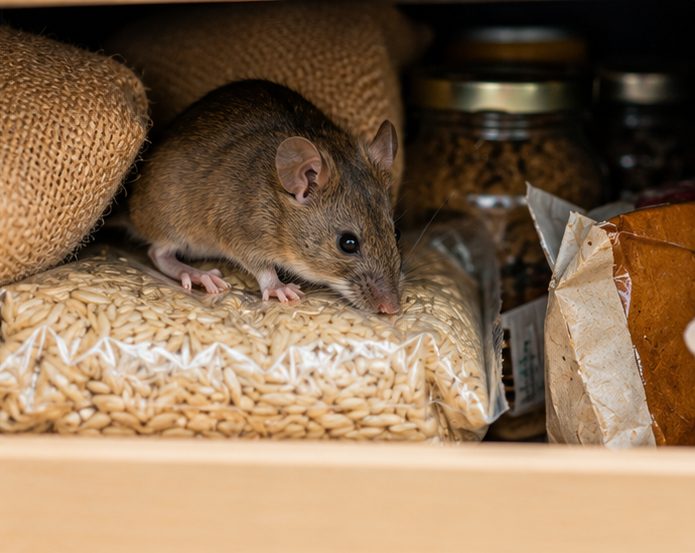
House mouse among food packaging in a kitchen cupboard, with gnawed bags and spilled contents

Reading the Signs

Droppings

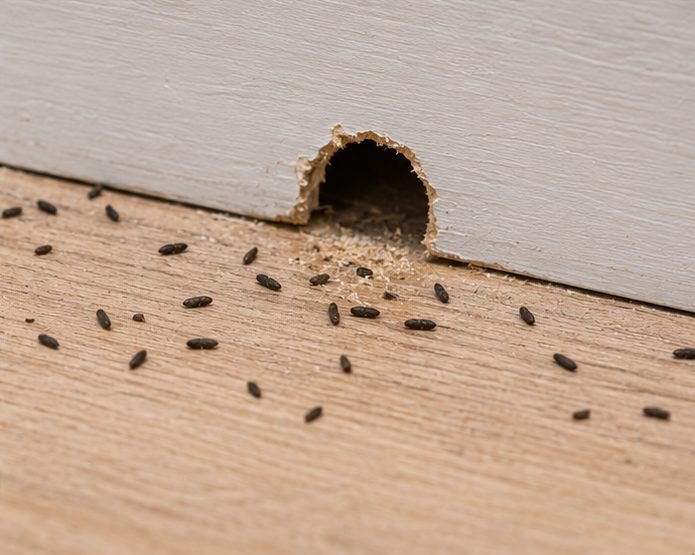
The most useful evidence there is, because they tell you where the activity is concentrated. Mouse droppings are small and dark, and mice produce a lot of them. Look along skirting, in the back of cupboards, under the sink, behind appliances and in the airing cupboard.

Fresh droppings are dark and soft; old ones are grey, dry and crumble. That difference tells you whether you are looking at a current problem or an old one.

Sounds

Scratching and scurrying in the small hours, usually from a ceiling void, a wall or under the floor. Mice are largely nocturnal, so activity in daylight often means the population is large enough that they are competing.

Damage

Gnawed food packaging, often with the contents spilled. Gnawing at the corners of cupboards and doors. Shredded paper, insulation or fabric used for nesting.

Smear marks

Dark greasy marks along a regular route, where the same run is used repeatedly. These are genuinely useful because they map the route rather than just showing presence.

Smell

An established population has a distinctive musky ammonia-like smell, most noticeable in an enclosed space such as a cupboard or a loft.
The one that catches people out: seeing a mouse crossing a floor in daylight. Mice avoid open spaces and prefer to run along edges under cover. One out in the open in the daytime usually means there are more than you think, not that a single mouse got lost.
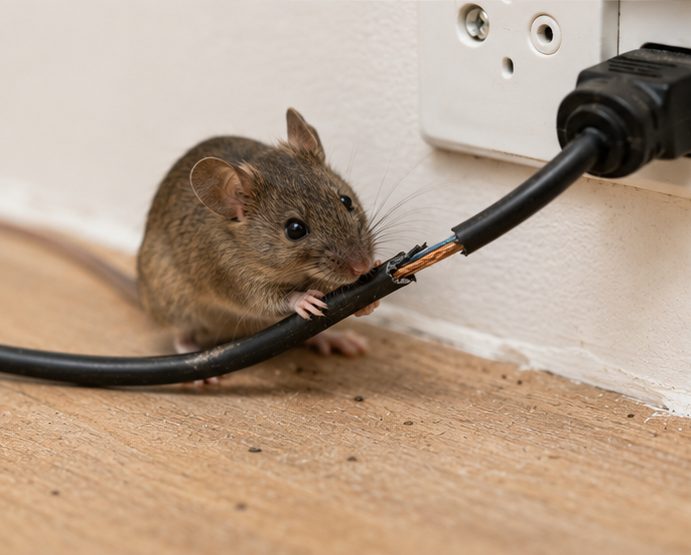
House mouse gnawing through electrical cable at skirting level Mouse droppings beside a gnawed hole at the base of a skirting board

What the Treatment Involves

  1. Survey. Where the activity is, how extensive it is, and how they are getting in — inside and outside the property.
  2. A treatment plan appropriate to the household. What is used and where depends on whether there are children, pets or wildlife concerns, and we discuss that before starting rather than after.
  3. Placement in protected locations that non-target animals cannot reach.
  4. Follow-up visits to monitor and to remove what has been caught.
  5. Proofing advice — the specific gaps, in priority order, and what to fill them with.
  6. Confirmation that the activity has stopped before we sign it off.

Proofing: What Actually Works

  • Wire wool packed into a gap and sealed — mice will gnaw through expanding foam and sealant on their own, but not through a properly packed metal fill
  • Metal or heavy-duty bristle strips at the base of external doors
  • Proper air brick covers rather than a rag or a piece of card
  • Sealing around pipe and cable entries with a rodent-resistant material
  • Cutting back branches and climbing plants that reach the roof
  • Making sure the drain and gully covers are intact

Proofing is worth doing properly, and it is worth doing all of it. Mice only need one route, so nine gaps closed and one left open is not ninety per cent of a solution.

What You Can Do

  • Store dry food in sealed hard containers rather than in packets
  • Clear crumbs and spills, especially behind and under appliances
  • Do not leave pet food down overnight
  • Keep bin bags off the floor and lids closed
  • Clear clutter from the areas where activity is showing, so there is less harbourage
  • Take a photograph of any droppings before you clear them — it helps with identification

Mice Control Cost — Common Questions

Is £260 the whole price?
£260 is our mouse control price, the same figure as rat control, and there is no call-out fee on top. We confirm it with you before booking. Proofing work — physically closing the ways in — is a separate service at £180 for up to an hour, because not every customer wants it done by us.
I set traps and caught two. Why are there still mice?
Because you almost certainly did not have two. Mice are seen at the edges of their range, and by the time one is crossing a kitchen floor in daylight there is usually a established population somewhere less visible.
How small a gap can a mouse get through?
BPCA puts it at 5mm — roughly the diameter of the eraser on the end of a pencil. They also climb well and travel through cavities, pipe runs and cable routes, so the entry point is often nowhere near where you see them.
Is it just one mouse?
Occasionally, particularly in autumn when they come in from outside. But mice breed quickly and a single sighting is worth taking seriously rather than assuming it is a lone visitor.
Do I need to move out or empty the kitchen?
No. We will tell you what to clear and what to keep sealed, and it is a matter of tidying rather than emptying.
What about my pets and children?
Tell us before we start. Where there are pets or small children, treatment is placed in protected locations they cannot reach, and there are approaches that do not involve rodenticide at all — we will discuss what suits the property.
Why can I smell something after the treatment?
It can happen where a mouse dies in an inaccessible void. It is unpleasant and it is temporary. Tell us and we will advise — sometimes the location can be found and sometimes the honest answer is that it has to pass.
Will you tell me how they are getting in?
Yes, and it is the most valuable part of the job. Proofing is what stops the problem returning; a treatment without it deals with the mice that are there and nothing more.

Get a Price for Your Property

Tell us what you have found. We confirm the treatment and the price before anything is booked.

Other Pest Control Prices in Cambridge

All pest control prices →

Need Help With Mice Control in Cambridge?

Tell us what you have seen and where, and we will give you the treatment and the price before we book anything.