£90 Fixed Price

How Much Does Wasp Nest Removal Cost in Cambridge?

£90, fixed, fully guaranteed — and it is one price whether the nest is in a shed or three storeys up under a roof tile.

Wasp Nest Removal Cambridge

£90

Fixed Cost – Fully Guaranteed

Most pest-control pricing comes with conditions attached. This one does not: wasp nest treatment in Cambridge is £90, fixed, and fully guaranteed.

That figure does not change with the height of the nest, the size of the colony, or how awkward the access is. It is the same price for a nest in a garden shed and a nest under a roof tile on the third storey.

What the £90 Covers

  • Attendance at your property — there is no separate call-out fee
  • Locating the nest, which is not always where people think it is
  • Professional treatment of the nest
  • The guarantee: if the treated nest is still active, we come back
  • Advice on the site, and on anything that makes a repeat likely
Why one price works for us. A wasp treatment is a well-defined job. Once a technician is on site with the right equipment, treating a nest takes broadly the same time and the same materials wherever it is. Charging by height or difficulty would mean quoting each job individually, which is slower for you and, on average, no cheaper.

How the Treatment Actually Works

This is worth understanding, because it explains the one instruction we give afterwards.

An insecticidal dust is applied at the nest entrance. Foraging wasps walk through it on their way in and carry it into the nest on their bodies, where it spreads through the colony — including to the parts of the nest nobody can reach. That is why the treatment reaches a nest inside a wall cavity or under a floor, where nothing could be sprayed directly.

It also means the wasps have to be able to get back in.

So do not block the hole. It is the commonest thing people do and it is the one thing that stops the treatment working.

Blocking a nest entrance has a second problem. Wasps that cannot get back in the way they came will chew at the surrounding material looking for another route — and where the nest is in a cavity, that new route sometimes comes out on the inside of the building.
What Happens on the Day

  1. We find the nest. Often the entrance is obvious once you watch for a minute — a steady two-way stream of wasps going in and out of one point. Sometimes it is not, and that is part of the job.
  2. We clear the area. People and pets indoors, windows closed on that elevation, and anyone in the garden moved well back.
  3. The nest is treated at the entrance.
  4. Activity increases briefly. This is normal and it is a good sign — it means the treatment has reached the colony.
  5. It quietens over the following hours, usually finishing within a day or two depending on the size of the colony and the weather.
  6. You leave the entrance alone until it has gone quiet.
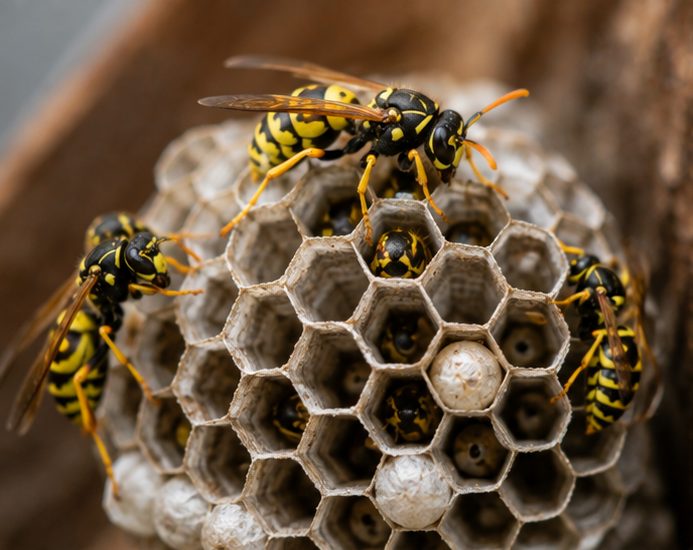
Exposed wasp nest comb with common wasps and capped brood cells

Where Nests Turn Up in Cambridge Properties

  • Roof spaces and under tiles — the most common by a distance
  • Wall cavities, entered through an airbrick or a gap in the pointing
  • Soffits and fascia boards, especially where there is a gap at a joint
  • Sheds, garages and outbuildings
  • Bird boxes and compost bins
  • Underground, in a bank or an old rodent burrow — these are easy to walk into with a mower and are worth taking seriously
  • Hedges and shrubs, where the nest is visible and often large
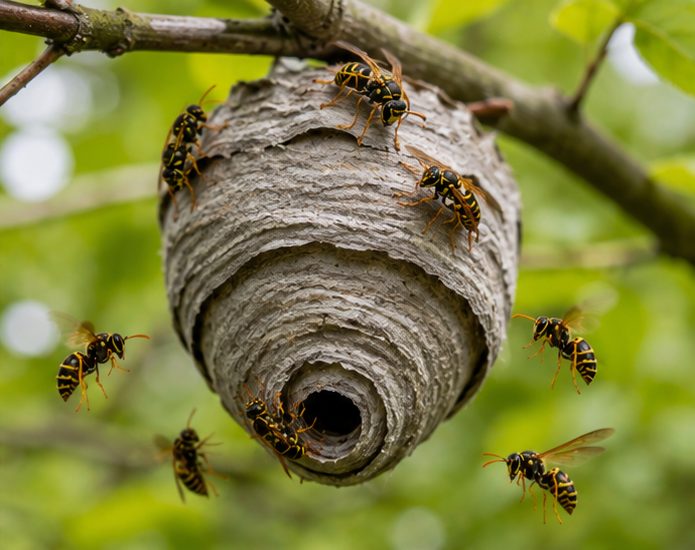
Aerial wasp nest hanging from a branch with wasps flying in and out of the entrance

Why They Get Worse in Late Summer

The change in wasp behaviour from August onwards is real, and there is a reason for it.

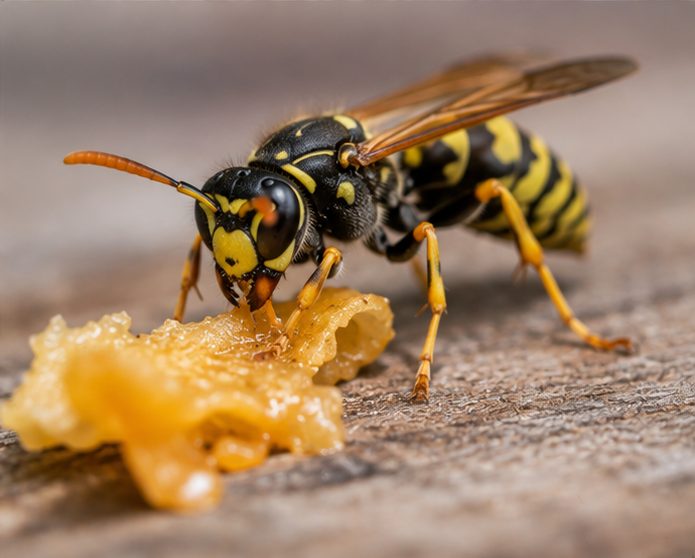
For most of the year the workers are collecting protein for the larvae, and in return the larvae produce a sugary secretion that feeds the adults. Late in the season the queen stops laying, the larvae pupate, and that sugar supply stops. The workers, with no brood to feed and nothing feeding them, go looking for sugar elsewhere — which is why they suddenly appear round pub tables, fallen fruit and bins, and why they are far more inclined to be aggressive about it.
The colony dies out anyway — so is it worth treating in September? Often, yes. A late-season nest can still hold a large number of wasps and they are at their most difficult at exactly that point. If the nest is somewhere you need to use — a doorway, a shed, a garden you want to sit in — it is worth dealing with rather than waiting it out.
Common wasp feeding on fallen fruit in late summer, when the colony switches to sugar

Wasps, Bees and Hornets

Worth checking before you book anything, because the answer changes what should happen.

  • Honey bees should not be treated. If you have a swarm or a colony in a chimney or a cavity, a local beekeeper is the right first call.
  • Bumblebees are docile, their nests are small and short-lived, and they are best left alone where that is possible at all.
  • Solitary bees — the small ones going into holes in mortar or a lawn — do not defend a nest and are not a pest.
  • European hornets are larger than wasps and much less aggressive than their size suggests. They can be treated where a nest is genuinely in the way.
  • Wasps are the ones people normally mean, and the ones this £90 treatment is for.

If you are not sure what you have, describe it to us or send a photograph. It costs nothing to check and it is better than treating something that did not need it.

What You Can Do Yourself

Honestly: not much, and the shop-bought aerosols are the reason we get called out to half-treated nests.

A can of wasp spray reaches perhaps a metre or two and treats the wasps you can see. The nest carries on. What it reliably achieves is a colony that is now agitated, and a person standing underneath it on a ladder.

What is worth doing is prevention for next year: seal gaps around soffits and airbricks over the winter, keep bins closed and away from doors, and clear fallen fruit in late summer.

Wasp Nest Removal Cost — Common Questions

Is £90 really the whole price?
Yes. It is a fixed cost, not a starting figure, and there is no call-out fee on top. If we attend and treat a nest, the price is £90.
What if there is more than one nest?
The £90 covers the treatment of a nest. If we find a second, genuinely separate nest on the property we will tell you before treating it and what it will cost — you will not get a larger invoice without a conversation first.
What does “fully guaranteed” mean?
If the treated nest is still active after the treatment has had time to work, we come back and deal with it. The specific terms are confirmed when you book.
Should I block up the entrance hole?
No — and this is the single most common mistake. The treatment works because returning wasps carry it into the nest. Sealing the hole stops that, and it can also push the wasps to chew a new way out, sometimes into the room below.
Will the nest be physically removed?
The treatment kills the colony, which is what stops the problem. Physically removing the structure is sometimes possible and sometimes not, depending on where it is. An empty nest is harmless and will not be reused.
Do wasps come back to the same nest next year?
No. Wasp nests are annual. The colony dies out over the autumn and a new queen builds somewhere fresh the following spring. A nest in the same spot two years running is a new nest, not a returning one.
Is it more expensive if the nest is high up?
No. Height and location do not change the price — it is £90 whether the nest is in a shed at ground level or under a tile at roof height.
How quickly can you come?
Wasp work is the thing we prioritise, particularly where someone in the household reacts badly to stings or where the nest is next to a door or a play area. Call and tell us where it is.

Get a Price for Your Property

Tell us what you have found. We confirm the treatment and the price before anything is booked.

Other Pest Control Prices in Cambridge

All pest control prices →

Need Help With Wasp Nest Removal in Cambridge?

Tell us what you have seen and where, and we will give you the treatment and the price before we book anything.