£180 for Up to 1 Hour

How Much Does Rat and Mice Proofing Cost in Cambridge?

£180 for up to an hour of proofing work. Treatment removes the rodents that are there. Proofing is what stops the next ones — and it is the half people skip.

Rat & Mice Proofing Cambridge

£180

Up to 1 Hour

Rat and mice proofing in Cambridge is £180 for up to one hour of proofing work.

It is priced by time rather than by room because that is genuinely how the job works — it depends on how many gaps there are and how awkward they are to reach, not on the size of the house.

Why This Is the Half That Matters

A rodent treatment deals with the animals that are in the building. It does nothing whatever about the hole they came through.

That is not a criticism of treatment — you cannot proof a property with an active population inside it, so the treatment has to come first. But a property that admitted mice once will admit them again, usually in the same season next year, and the people who call us back a year later are almost always the ones who did the treatment and stopped there.

Treatment is what you need now. Proofing is what decides whether you need us again.

What Actually Works

Materials matter here more than technique, because rodents gnaw.

MaterialVerdict
Wire wool packed tight and sealed overThe standard. Rodents will not gnaw through it
Metal plate or meshExcellent for larger openings and damaged air bricks
Proper air brick coversRight answer for air bricks — and cheap
Metal or heavy bristle door stripsRight answer for a worn threshold
Expanding foam aloneRodents gnaw straight through it
Silicone or acrylic sealant aloneSame — it is a filler, not a barrier
Cardboard, cloth, plastic bagNesting material, not proofing
The rule of thumb: if you could get through it with your teeth given a week, so can a rat. Anything that works is either metal or has metal in it. Foam and sealant have a place — as the thing that finishes and seals a gap already packed with wire wool — but never on their own.
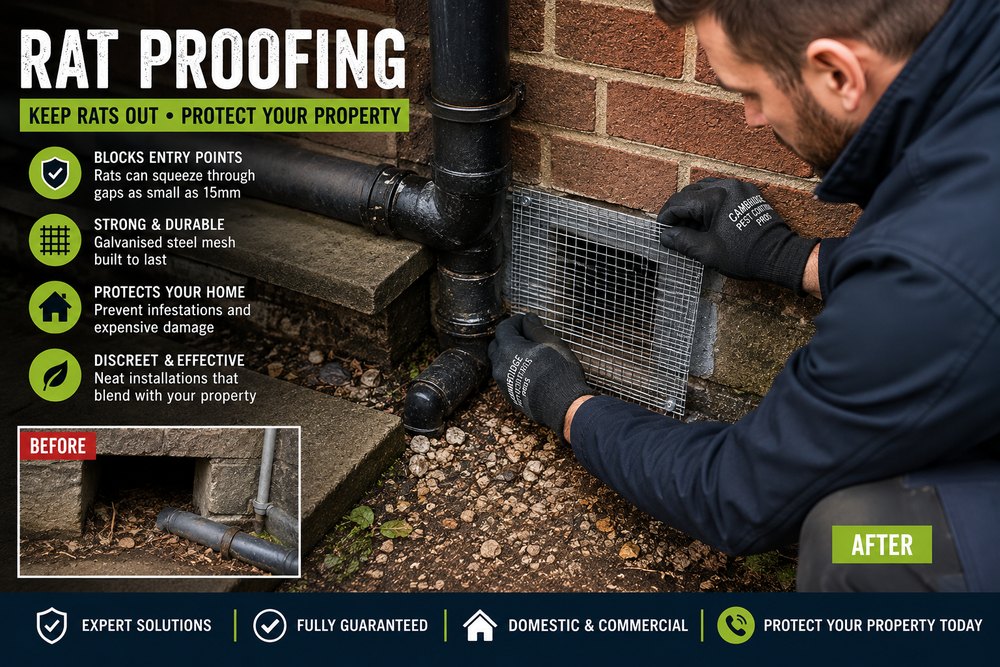
Cambridge Pest Control Pros technician fitting galvanised steel mesh over an open airbrick to block a rat entry point, shown before and after

Where the Gaps Usually Are

  • Around pipe and cable entries — under the sink, behind the boiler, where the gas and water mains come in. The most common route by a distance
  • Air bricks with broken, missing or badly fitted covers
  • Under external doors, especially where a threshold has worn down
  • Where the floor meets the wall in older properties
  • Around soil and waste pipes where they pass through a wall
  • At the eaves and under roof tiles, reached from a fence, a drainpipe or an overhanging branch
  • Gaps into the cavity at ground level, which lead anywhere
  • Between adjoining properties in a terrace — which is why a neighbour's problem becomes yours

Two things surprise people. The first is how far a rodent will travel inside a structure, so the gap is frequently nowhere near where you saw them. The second is that mice climb confidently — a gap at roof level is as usable as one at the doorstep.

What an Hour Realistically Covers

We would rather set the expectation properly than have you disappointed.

  • A typical domestic property with a handful of identified access points is usually dealt with inside the hour
  • A property with extensive gaps, or with awkward high-level access needing ladders, may take longer
  • Work needing scaffolding, roof access or building repairs is not proofing — it is building work, and we will say so rather than charging you by the hour for something we cannot finish
  • Drainage defects are a drainage repair, not proofing

Where more than an hour is needed, you get told what is outstanding, what it will take and what it will cost before we carry on.

The Right Order

  1. Survey — find the activity and the access points.
  2. Treat — deal with the rodents that are present.
  3. Confirm the property is clear.
  4. Then proof.
Doing it in the wrong order causes a specific problem. Sealing a building that still has an active population inside traps rodents in the structure. They will gnaw to get out, and an animal that dies in an inaccessible void produces a smell you cannot do much about. Proofing is the last step, not the first.

What You Can Do Alongside It

Proofing closes the building. These reduce the reason anything is interested in it:

  • Store dry food, including pet food and bird seed, in sealed hard containers
  • Keep bin lids closed and bags off the ground
  • Clear spilled seed from under bird feeders — the commonest rat attractant in a domestic garden
  • Keep compost heaps free of cooked food, meat and bread
  • Cut back ivy, climbing plants and branches that reach the roof
  • Clear dense cover, log piles and rubbish from against the walls
  • Check that drain and gully covers are intact

Rat & Mice Proofing Cost — Common Questions

What does the £180 cover?
Up to one hour of physical proofing work — sealing the gaps and access points that let rodents in, using materials they cannot gnaw through. Most domestic properties are dealt with within the hour.
What if my property needs more than an hour?
We tell you what is left, what it will take and what it will cost before carrying on. You will not get an invoice for three hours you did not agree to.
Is proofing included in the £260 treatment?
No, they are separate services. The treatment deals with the rodents present; proofing is physical work on the building. Keeping them separate means you are not paying for proofing if you would rather have your own builder do it.
Can I just do it myself with expanding foam?
You can try, and rodents will gnaw straight through it. Expanding foam and ordinary sealant are not rodent-resistant on their own. What works is wire wool packed tightly into the gap and then sealed, or a metal plate or mesh over the opening.
How small a gap matters?
BPCA puts a mouse at 5mm — roughly the diameter of a pencil eraser — and a rat at 15mm. Those are the sizes they need as they are; both species gnaw, so a smaller hole today is not necessarily a smaller hole next month.
Is proofing worth it if I have not had a problem?
If you have never had rodents, it is not usually the first thing to spend money on. If you have had them once, it is the single most useful thing you can do, because a property that let them in once will do it again.
Do you proof drains?
Drain defects are a common rat route, and we will identify one if we find it — but the repair is drainage work rather than proofing, and we will tell you plainly when that is what you need.
Will proofing alone get rid of the rodents I already have?
No, and it can make things worse if done in the wrong order. Sealing a building with an active population inside traps them in. Treat first, proof once it is clear.

Get a Price for Your Property

Tell us what you have found. We confirm the treatment and the price before anything is booked.

Other Pest Control Prices in Cambridge

All pest control prices →

Need Help With Rat & Mice Proofing in Cambridge?

Tell us what you have seen and where, and we will give you the treatment and the price before we book anything.