£260

How Much Does Rat Control Cost in Cambridge?

£260. Rats are the one to deal with promptly — and in a surprising number of cases the real answer is a defective drain rather than a bait station.

Rat Control Cambridge

£260

Rat control in Cambridge is £260, confirmed before booking, with no call-out fee.

Of everything on our price list, this is the one we would most encourage you not to put off. Rats breed quickly, they gnaw persistently, and a small problem becomes a large one faster than most people expect.

Start With the Drains

This is the single most useful thing to know about rat control, and it is the reason some rat problems keep coming back after apparently successful treatments.

Brown rats live in and travel through the sewer system. That network runs directly underneath and into every property, and it is a warm, food-rich, entirely sheltered environment. Where the drainage is intact, they stay in it. Where it is not, they come up.

  • A cracked or collapsed section of pipe
  • A displaced or open joint
  • A redundant branch that was capped off badly, or not at all, during building work
  • A missing or broken rodding eye cover
  • A defective or missing gully
  • An old, disused toilet connection left open under a floor

If rats return to the same property after treatment, the drains are the first place to look — not the second.

Where that leaves us being straight with you. If the evidence points at the drainage, we will tell you, and the fix is a drainage repair rather than another treatment. Selling you a third round of baiting for a problem that has an open pipe underneath it would be taking your money for nothing.

Reading the Signs

Droppings

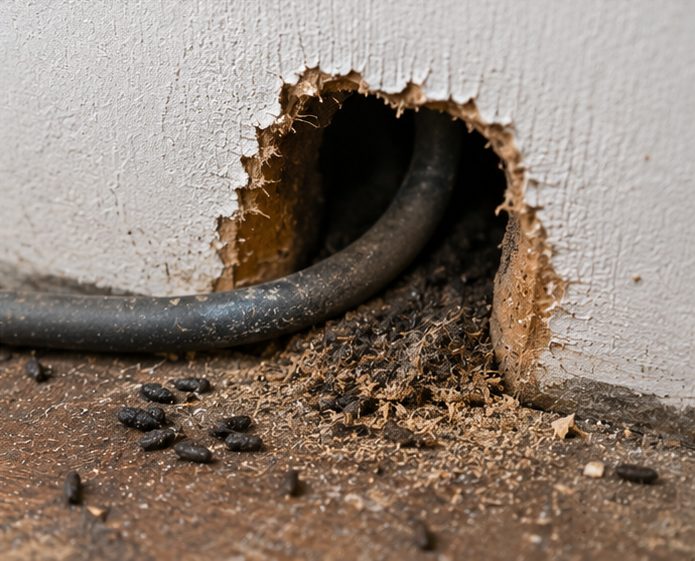
Noticeably larger than mouse droppings, dark, and usually found in groups along a route or near a food source. Fresh ones are dark and soft; older ones dry, grey and crumbly.

Runs and smear marks

Rats are creatures of habit and use the same routes repeatedly, leaving dark greasy smears where they brush against a wall, a joist, a pipe or the edge of a hole. Outdoors, look for worn tracks through grass, along fence lines and under decking.

Burrows

Holes in banks, under sheds and decking, alongside foundations, at the edge of a compost heap. An active burrow is clear of cobwebs and debris, with loose soil at the entrance.

Gnawing

Rat incisors grow continuously, so they gnaw constantly to wear them down — on wood, plastic, pipework, insulation and cabling. Gnawed cable is the reason a rat problem in a loft is more than a nuisance.

Noise

Heavier than mice — scuffling, scratching and sometimes an audible thump, usually from a loft, under a floor or in a wall.

Disturbed insulation

Loft insulation pushed into tunnels and heaps is a strong indicator, and it is often the first thing noticed when somebody goes up for the Christmas decorations.
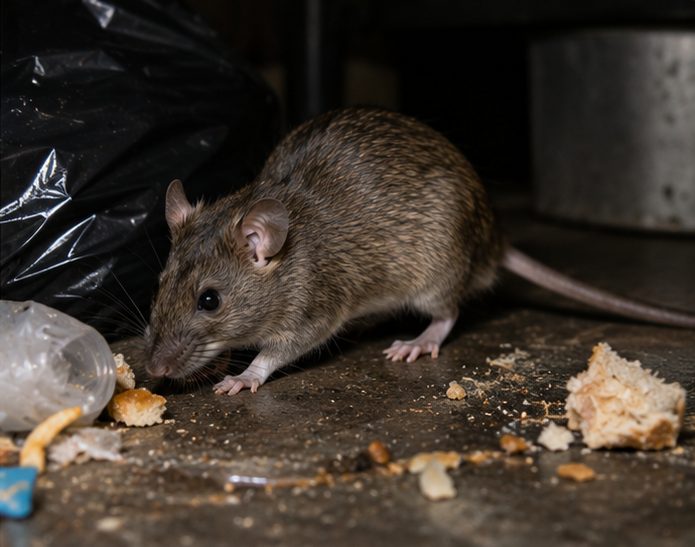
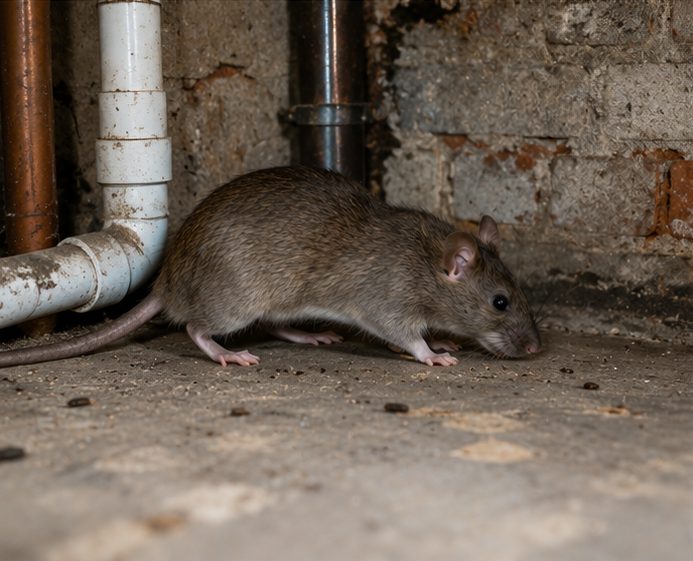
Brown rat feeding on food waste beside bin bags, a common garden attractant Brown rat travelling along pipework, one of the routes rats use to move through a building

Health, Briefly and Accurately

Rats carry organisms that can cause illness in people, of which leptospirosis — Weil's disease in its severe form — is the one usually named. Infection is uncommon but it is a real risk, and it is spread through contact with rat urine, particularly via broken skin or contaminated water.

The sensible precautions are ordinary ones: wear gloves when clearing anything they have been in contact with, wash your hands properly afterwards, do not eat food they may have reached, and cover cuts and grazes before working in an area with activity.
What the Treatment Involves

  1. Survey. Inside and outside, including drainage covers, the garden, outbuildings and the loft.
  2. Establishing the route. Where they are getting in and where they are coming from, which are not always the same question.
  3. A treatment plan appropriate to the household, discussed with you where there are pets, children or wildlife to consider.
  4. Treatment in protected locations that non-target animals cannot reach.
  5. Follow-up visits — rat work almost always needs more than one. BPCA describes rats as neophobic, meaning they have a fear of new objects, so equipment has to be left in place long enough to stop being new before it does anything.
  6. Proofing recommendations, and a clear statement where the answer is drainage or building work rather than pest control.
  7. Confirmation that activity has stopped before signing off.
Cable entry gnawed open by rats, with droppings below — a typical access point

What Draws Them to a Garden

  • Bird feeders. Spilled seed under a feeder is the commonest single attractant in a domestic garden.
  • Compost heaps containing cooked food, meat or bread
  • Poorly stored bins, or bags left out overnight
  • Chicken and pet feed left accessible
  • Dense cover — deep ivy, log piles, overgrown corners, the space under decking and sheds
  • Standing water, which they need daily

Removing the attractant will not clear an established population on its own, but it makes the treatment work faster and makes a repeat considerably less likely.

Rat Control Cost — Common Questions

Is £260 the whole price?
£260 is our rat control price, the same as mice control, with no call-out fee. Proofing — physically sealing the ways in — is a separate service at £180 for up to an hour. Where the real fault is a defective drain, that is drainage work and we will say so rather than selling you another treatment.
Why should rats be dealt with quickly?
Three reasons: they breed quickly, they gnaw persistently — including at things you would rather they did not, such as cabling and pipework — and they carry organisms that can make people ill. It is not a problem that improves on its own.
What is the connection with drains?
Rats live in the sewer system and travel through it. A cracked pipe, a displaced joint, a redundant capped-off branch or a missing rodding eye gives them a route straight up into a property or its garden. If a rat problem keeps recurring after treatment, the drains are the first thing to look at.
Can you fix the drain?
We identify it as the likely route and tell you what we have found. The repair itself is drainage work — we will tell you plainly when that is what you need rather than selling you another treatment.
Is a rat in the garden a problem?
Not necessarily, but it is worth understanding why it is there. Rats in gardens are usually drawn by a food source — bird feeders, a compost heap with cooked food in it, poorly stored bins, chicken feed. Deal with the source and the garden becomes far less interesting.
Do I have to report it to the council?
There is no obligation on a householder to report rats. If the source appears to be a public sewer, a neighbouring property or council land, the council may be the right people to involve, and we will say so if that is what we find.
Are the treatments safe around pets and children?
Tell us what is in the household before we start. Treatment goes in protected locations that non-target animals cannot access, and there are approaches that avoid rodenticide where that is the right call.
How long does it take?
Rat work normally needs more than one visit — an initial treatment, monitoring, and confirmation that the activity has stopped. We tell you what to expect at the start.

Get a Price for Your Property

Tell us what you have found. We confirm the treatment and the price before anything is booked.

Other Pest Control Prices in Cambridge

All pest control prices →

Need Help With Rat Control in Cambridge?

Tell us what you have seen and where, and we will give you the treatment and the price before we book anything.