£280 Fixed Cost

How Much Does Squirrel Trapping Cost in Cambridge?

£280, fixed. There is a legal point here that most people do not know, and we would rather you heard it from us before you book than afterwards.

Squirrel Trapping Cambridge

£280

Fixed Cost

Squirrel trapping in Cambridge is £280 fixed cost.

Before anything else, there is a legal point that we tell every customer before they book, because a lot of people are surprised by it and nobody should find out afterwards.

A Trapped Grey Squirrel Cannot Be Released

Under section 14 of the Wildlife and Countryside Act 1981, it is an offence to release, or to allow to escape into the wild, any animal included in Schedule 9 to that Act. The grey squirrel is listed in Schedule 9.

That means catch-and-release is not an option — not for us, and not for anybody. A grey squirrel that has been trapped must be humanely dispatched.

So be cautious of anyone offering to relocate one. A company promising to catch your squirrel and let it go in a nice bit of woodland is either describing a criminal offence or is not going to do what it says. We would rather tell you this plainly at the quotation stage than have you find out later.

The reason for the law is straightforward: the grey squirrel is a non-native species that has displaced the native red squirrel across most of Britain and does substantial damage to woodland. The legislation exists to stop it being spread further.

We understand this sits uncomfortably with some people, and we would rather have that conversation honestly up front than take a booking under a misunderstanding.

Why It Costs £280

More than a rodent treatment, and for a specific reason: this is a programme, not a visit.

  • Traps must be sited correctly, which requires knowing where the animal is actually travelling rather than where it was heard.
  • Traps must be checked frequently — best practice is at least daily — because no animal should be left in a trap. That means repeated attendance in person, and it is the single biggest cost in the job.
  • Traps have to be legally compliant. It is an offence to use a spring trap that is not approved for the species under the relevant Spring Traps Approval Order.
  • Traps must exclude non-target animals, which in practice means setting them in a natural or artificial tunnel with a restricted entrance so that cats, birds and other wildlife cannot get in.
  • It takes as long as it takes. A squirrel does not enter a trap to a schedule.

£280 buys the programme and the attendance. That is what the work actually consists of.
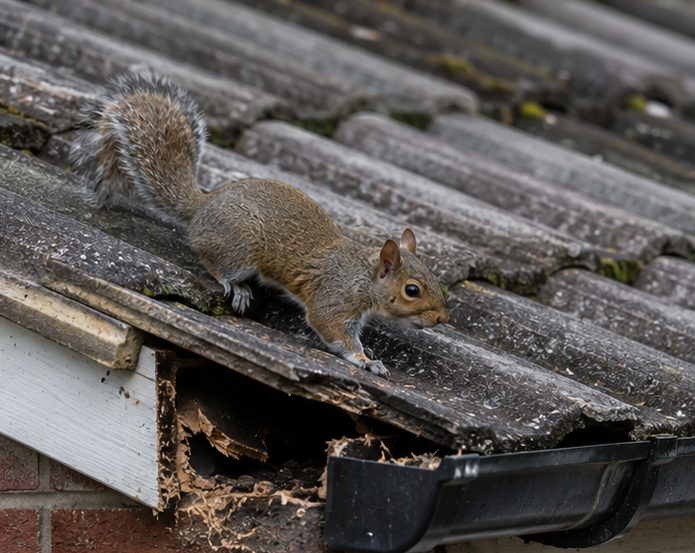
Grey squirrel on a roof at a damaged soffit, the usual way into a loft

How to Tell It Is a Squirrel

Loft noises get blamed on all sorts of things. Squirrels have a fairly distinctive signature.

What you noticePoints towards
Heavy, confident movement in daylight, especially early morning and late afternoonSquirrels — they are day-active, unlike rats and mice
Rolling or dragging soundsSquirrels caching food in the loft
Loud gnawing on timberSquirrels — the scale is greater than a rodent
Scratching in the small hours, quiet by dayRats or mice
Scrabbling and calls in spring, near the eavesPossibly nesting birds
Fluttering, mainly at duskBats — which are legally protected; stop and take advice before doing anything
If you think it might be bats, stop. All UK bat species and their roosts are legally protected, and disturbing a roost is a serious matter. Nothing should be blocked, treated or trapped until it has been properly identified. Tell us and we will advise.
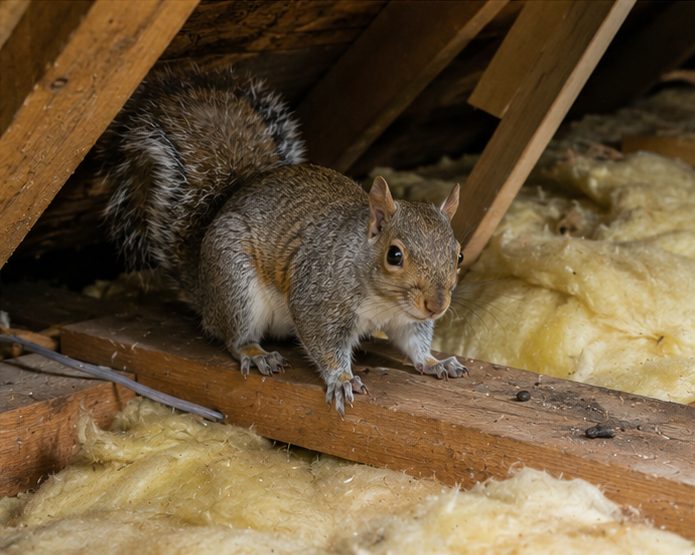
Grey squirrel in a loft among disturbed insulation and roof timbers

What They Damage

  • Electrical cabling — the one that genuinely matters. Squirrels gnaw constantly and stripped cable in a roof space is a fire risk.
  • Roof timbers and joinery
  • Water pipes and tanks, with the obvious consequences
  • Insulation, compacted, tunnelled through and used for nesting
  • Stored belongings, chewed and contaminated
  • Soffits, fascias and roof tiles, enlarging the way in

What the Job Involves

  1. Survey. Confirming it is squirrels, establishing how many, and finding the access points — outside as well as in the loft.
  2. Assessing the season. Whether there could be dependent young, because that changes what can responsibly be done and when.
  3. Siting legal, tunnelled traps where the animals are actually travelling.
  4. Regular attendance to check them.
  5. Humane dispatch of what is caught, as the law requires.
  6. Confirming the loft is clear.
  7. Proofing advice — the specific gaps to close, and when.

The order of the last two matters. Sealing a roof space before it is clear traps an animal inside, which is bad for the animal and worse for your roof — a squirrel shut in will chew its way out, usually through something expensive.
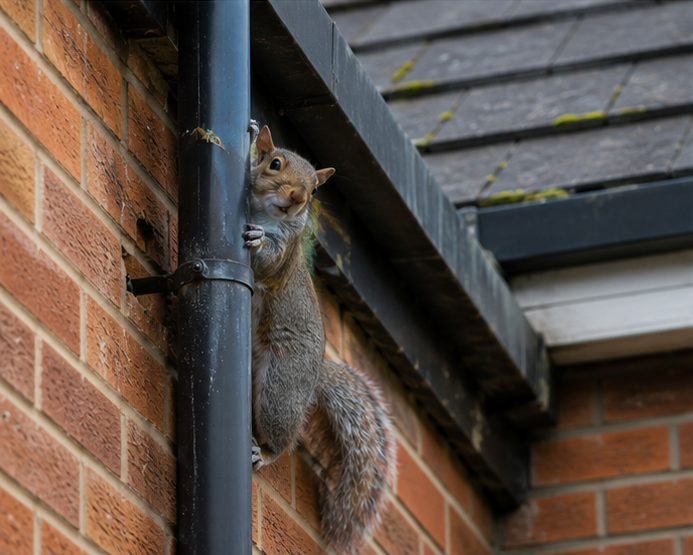
Grey squirrel climbing a downpipe to reach the roofline of a house

Keeping Them Out Afterwards

  • Close gaps at the eaves, at soffit and fascia joints, and where a bay or extension roof meets the main roof
  • Repair or replace displaced and broken tiles
  • Fit proper covers to vents and airbricks
  • Cut back branches that overhang or reach the roof — squirrels jump a considerable distance, so trimming to the wall is not enough
  • Check the loft occasionally, particularly in autumn when they look for somewhere to overwinter

A roof that admitted one squirrel will admit the next. Proofing is the part of the job that decides whether you need us again.

Squirrel Trapping Cost — Common Questions

Can you catch the squirrel and release it somewhere else?
No, and no one lawfully can. Under section 14 of the Wildlife and Countryside Act 1981 it is an offence to release, or allow to escape into the wild, an animal listed in Schedule 9 — and the grey squirrel is on that list. A trapped grey squirrel must be humanely dispatched. Any company offering to catch and relocate one is describing an offence.
Why is the law like that?
The grey squirrel is a non-native species that has displaced the native red squirrel across most of the country and causes significant damage to woodland. The legislation is designed to prevent it being spread further.
Is £280 a fixed price?
Yes, fixed cost. It covers the trapping programme rather than a single visit, because trapping takes time and requires repeated attendance.
Why does it cost more than rats or mice?
Because it is a programme of visits rather than a treatment. Traps have to be sited, checked regularly, and attended in person — legally and ethically they cannot simply be left.
How often do the traps have to be checked?
Best practice is at least daily, because an animal must not be left in a trap. That requirement for repeated attendance is the main reason squirrel work is priced as it is.
Can you just block the hole they are using?
Not until we are certain nothing is inside, and not during the breeding season if there could be dependent young. Sealing an adult out while young are in the roof leaves you with an animal trying to chew back in and, eventually, a serious problem in the loft.
What damage do they actually do?
They gnaw. Roof timbers, water pipes, stored items, and — the one that matters — electrical cabling. They also disturb and compact loft insulation and can bring nesting material in.
Will they come back?
A roof space that let one in will let another in, which is why proofing is part of the job rather than an afterthought. We identify the access points and tell you what needs closing once the loft is clear.

Get a Price for Your Property

Tell us what you have found. We confirm the treatment and the price before anything is booked.

Other Pest Control Prices in Cambridge

All pest control prices →

Need Help With Squirrel Trapping in Cambridge?

Tell us what you have seen and where, and we will give you the treatment and the price before we book anything.