How to Get Rid of Ants in Your Cambridge Home
The honest version: you cannot solve this by killing the ants you can see, and most of what is sold for the job makes it harder rather than easier.
Read the guide →Signs to Look For
A few ants on a worktop is not an infestation. A trail is. Here is how to tell the difference, and what each sign is actually telling you.
Ants get into almost every Cambridge property at some point in the summer, and most of the time it means nothing at all. The useful question is not “are there ants” but “are they organised”.
A trail. Not ants, but ants following each other along the same route, repeatedly, over days.
That is the difference between a wanderer and a colony. When a foraging ant finds something worth having, it lays a pheromone trail on the way home. Other workers follow it and reinforce it, and within hours you have a defined line running from a gap somewhere to whatever they have found.
A trail means a colony has committed resources to your property. That is what is worth treating.
Behind the kettle, under the toaster, at the pet bowl, around the bin. Repetition is the signal — it means there is a food source they have locked onto, and finding it is usually half the solution.
More significant than ants coming in under a door. If they are coming out of the fabric of the building — a floor joint, a skirting board, a gap around a pipe — the route is established and may lead to a nest in or under the structure.
Small heaps of excavated material between paving blocks, at slab joints, or along the base of a wall. That is spoil from a colony digging below, and if it is against the house it is the likely source of anything you are seeing indoors.
One of the clearest indicators there is. A supermarket spray kills the foragers it touches; if the colony is established, replacements are out within a few days. Ants back within a week of spraying means the nest is untouched and near.
Winged ants outdoors in summer are the normal nuptial flight and need nothing. Winged ants emerging from inside the building are different — that means a mature colony in the structure, and a colony only produces winged forms once it is well established.
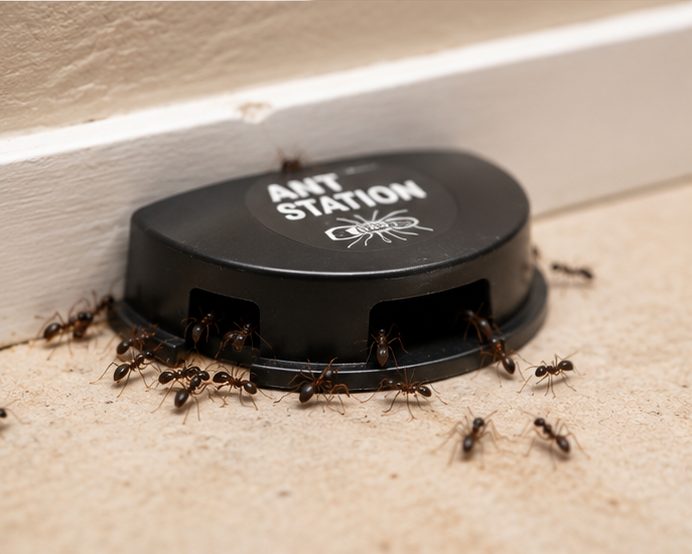
None of these needs treating, and anyone who tells you otherwise is selling you something you do not need.
That five minutes is genuinely useful information, and telling us what you found makes the visit faster.
Our ant control service is £240 fixed price and guaranteed, with no call-out fee. The cost guide sets out what that covers, and the main Ant Control Cambridge page explains the service in full.
If you are not certain the problem is ants at all, a pest inspection and survey is £120 fixed cost and settles it.
Tell us what you have found and where. We confirm the treatment and the price before anything is booked.
The honest version: you cannot solve this by killing the ants you can see, and most of what is sold for the job makes it harder rather than easier.
Read the guide →Almost always the black garden ant. But there is one species where getting it wrong and reaching for a spray turns a single problem into several.
Read the guide →Ants returning is not usually bad luck. It is one of five things, and four of them are fixable in an afternoon.
Read the guide →What the price covers, what changes it, and what happens on the day.
Read the price guide →We cover Cambridge and the surrounding towns. The main Ant Control Cambridge page covers the service in full.
Tell us what you have seen and where, and we will give you the treatment and the price before we book anything.