Rat Control in Huntingdon
£260
The service page for Huntingdon — what we do, what it costs and what to expect.
See the service →Rat Control — Huntingdon
A rat does not wander. It uses the same route, night after night, and that habit leaves a mark you can follow.
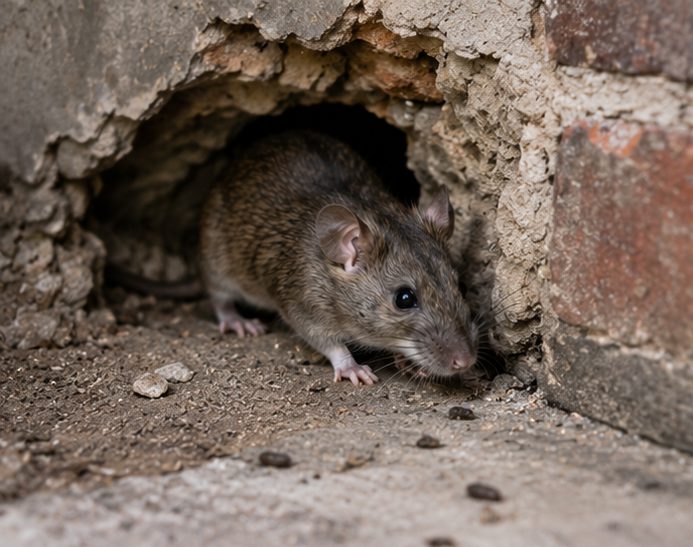
This is the outdoor equivalent of a smear mark, and it is the reason a survey spends as much time on the garden as on the building.
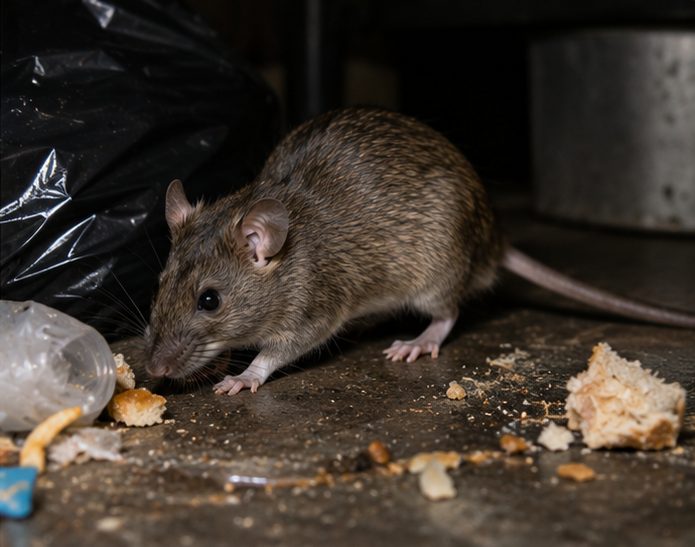
In soft ground, mud, dust or a light covering of snow you may find actual prints. A rat leaves a four-toed front print and a five-toed hind print, and frequently a continuous drag line from the tail between them. That drag line is the giveaway, and it is what separates it from most other things making prints in a garden.
| A run between | Tells you |
|---|---|
| Cover and the bins | The bins are the food source. Deal with them |
| Cover and a bird feeder | The commonest domestic rat attractant |
| A burrow and the building | They are working on getting in. Urgent |
| The boundary and a shed | The source may be off your property |
| A drain cover and cover | Worth thinking about the drainage |
| Two points on your boundary | They may be crossing rather than living here |
A run is only half a piece of information. Where it starts and where it finishes is the whole of it — one end is what is feeding them and the other is where they live, and dealing with either changes the situation permanently in a way that a treatment on its own does not.
Tell us what you have found and where. We confirm the treatment and the price before anything is booked.
The service page for Huntingdon, the other advice for this area, and every price we charge.
The service page for Huntingdon — what we do, what it costs and what to expect.
See the service →Before you buy anything, spend twenty minutes walking round the property with this list. It is free, and it is more effective than most of what people buy.
Read the guide →Droppings on their own are good evidence. Droppings read alongside the other four signs are close to conclusive.
Read the guide →It is rarely luck. A property that keeps attracting rats is offering something, and it is almost always one of three things.
Read the guide →Every price we charge, what it covers and what happens on the day.
Read the price guide →The main Rat Control Cambridge page covers the service in full.
Tell us what you have seen and where, and we will give you the treatment and the price before anything is booked.