Rat Control in Saint Ives
£260
The service page for Saint Ives — what we do, what it costs and what to expect.
See the service →Rat Control — Saint Ives
Most people look indoors, where the noise is. The evidence is usually outside, and it is usually in the same eight places.
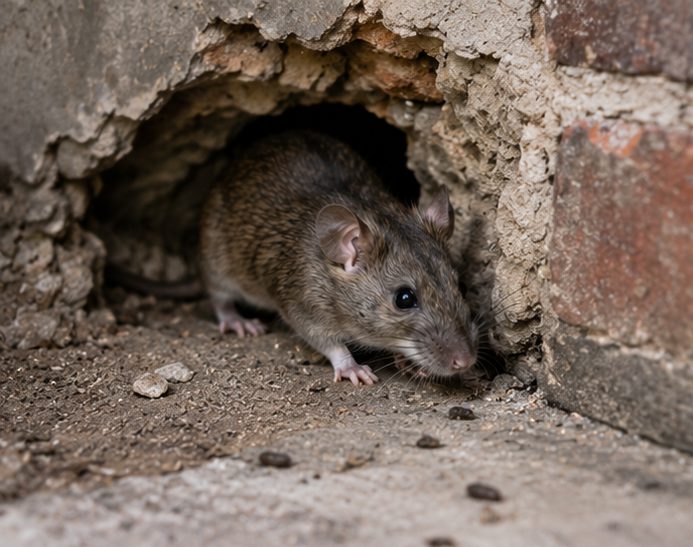
This is the circuit a technician walks, in roughly the order they walk it. It takes about twenty minutes, needs a torch and nothing else, and finds most of what there is to find.
Start here, because more domestic rat activity involves the bins than anything except bird feeders. Look for droppings around and behind the bins, gnawing on the lids or rims, and a flattened run between the bins and the nearest cover.
Not the feeder — the ground under it. Spilled seed is the commonest rat attractant in a domestic garden by a distance, and where there is activity there will be droppings in the grass and a run leading away to cover.
Look at the base and the sides for holes, and inside for tunnelling if it is an open heap. Cooked food, meat and bread in a compost heap are the difference between compost and a food source.
Inside for droppings, particularly in corners and behind stored items. Outside at the base for burrows, especially where the shed stands on bearers with a void beneath. Check the bottom corners of doors for gnawing.
The edge boards, and underneath with a torch if you can. Decking with an accessible void is close to ideal harbourage: dry, sheltered, undisturbed and usually attached to the house.
Walk the whole line. Look for gaps worn under a fence at a consistent point, runs through dense cover, ivy and brambles, and burrows in banks or among tree roots. Part the vegetation rather than looking at the top of it.
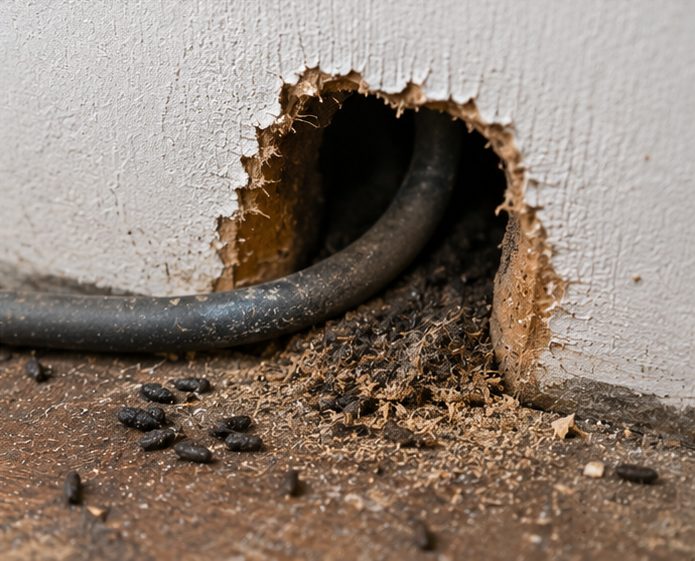
Slowly, all the way round, at ankle height with a torch held low. Pipe and cable entries, air bricks, door thresholds, gaps into the cavity at ground level, and any smearing at the edge of an opening — which is as close to proof of an entry point as this gets.
Lift what lifts easily and safely. Look for damage to the cover itself, gaps around the frame, missing rodding eye caps, and smearing inside. Drainage defects are the commonest cause of a rat problem that keeps returning after treatment.
Photograph it and leave it where it is. Note where each item was, because the map matters more than any single thing on it. Do not seal any opening you find until the property is confirmed clear.
If the circuit finds nothing at all and you are still hearing something, the problem is more likely inside the structure than around it, and a pest inspection and survey is a fixed cost and settles it.
Tell us what you have found and where. We confirm the treatment and the price before anything is booked.
The service page for Saint Ives, the other advice for this area, and every price we charge.
The service page for Saint Ives — what we do, what it costs and what to expect.
See the service →The question we are asked most often is whether it is safe with a dog in the house. It deserves a proper answer rather than a reassuring one.
Read the guide →There is one identification on this list that is not just a matter of buying the right product. Bats are protected, and acting on the wrong answer is a serious matter.
Read the guide →The treatment worked. That is not in dispute. The problem is that a treatment was the only thing that happened.
Read the guide →Every price we charge, what it covers and what happens on the day.
Read the price guide →The main Rat Control Cambridge page covers the service in full.
Tell us what you have seen and where, and we will give you the treatment and the price before anything is booked.